MN ASM November Tour of Honeywell Stinson Ridgway Factory
Tour the Still Amazing Honeywell Ring Laser Gyroscope
Thursday, November 19, 2026
2600 Ridgway Pkwy (Honeywell International Inc.), Minneapolis, MN 55413
Tour Guide: Al Touchberry, Principal Systems Engineer, Honeywell
Alan Touchberry is a principal system engineer for ring laser gyroscopes at Honeywell Aerospace. Al has worked on multiple engineering projects, including Honeywell’s RQ-16 T-Hawk vertical take-off landing micro air vehicle. Besides his current day job as an RLG systems engineer, Al is an amateur astronomer, a scientific coffee brewer, and a collector of grandfather clocks.
Abstract:
The ring laser gyroscope (RLG) is living proof that great technologies can improve with age. Some of my brilliant predecessors at Honeywell were instrumental in developing the first RLGs back in the 1960s. Since then, generations of Honeywell scientists and engineers have worked to continuously improve the product to keep pace with our customers’ changing requirements.
What is a ring laser gyroscope (RLG)?
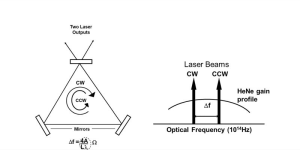
A Ring Laser Gyro (RLG) is a gyroscope that uses the optical Sagnac effect to sense rotation. Most commonly, the RLG is filled with a gas, such as Helium Neon (HeNe), and electrodes are used to excite light waves traveling in the clockwise (CW) and counterclockwise (CCW) directions. The light waves travel around an enclosed path steered by a series of mirrors, forming an optical cavity. In the presence of rotation, the clockwise and counterclockwise directions will have different path lengths due to the Optical Sagnac effect. Since the light waves are confined to an optical cavity, the difference is path lengths results in a frequency splitting between the CW and CCW light waves. The difference of frequencies is measured to determine the rotation rate.
Thanks to innovation and continuous improvement, the RLG is every bit as relevant today as it was when it was first introduced. There are competing technologies out there, but Honeywell’s GG1320AN is the navigation sensor of choice for most applications because it has a price-to-performance ratio that is world-class. The marketplace agrees because Honeywell has produced more than 500,000 GG1320ANs so far.
The talk begins at 5 pm, but please come half an hour early to get through security. 25 tickets will be available, but the tour is currently slated for only 20, the extra spots allowing for last minute cancellations.
Joining a group for dinner at the Tipsy Steer in Roseville following the tour is planned at your own expense.
Registration available from 4 pm October 29, 2026 until 5:00 pm, November 16, 2026
Due to site requirements, only US citizens can be allowed on the tour. Please bring government issued “paperwork” to show they are a US Person. Valid passport, birth certificate, etc.

MN ASM November Tour of Honeywell Stinson Ridgway Factory Read Post »